NVIDIA Chief Scientist Bill Dally Receives Computer Architecture’s Highest Honour

NVIDIA Chief Scientist Bill Dally Receives Computer Architecture’s Highest Honour
ACM, IEEE call Dally a visionary for his work advancing parallel processing
SINGAPORE — May 13, 2010 — Two leading computing organisations today honoured NVIDIA chief scientist Bill Dally with the Eckert-Mauchly Award, which is considered the world’s most prestigious prize for computer architecture.
In awarding the prize, the Association for Computing Machinery (ACM) and the IEEE Computer Society (IEEE) called Dally a “visionary” for advancing the state of computing using parallel processors. 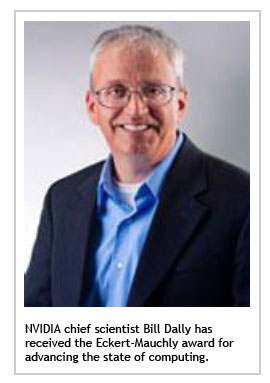
“This wonderful recognition reflects how Bill’s pioneering work in parallel processing is on its way to revolutionising computing,” said Jen-Hsun Huang, NVIDIA CEO and president. “We are delighted to have the benefits of his singular talent as we endeavour through our GPUs to bring parallel computing to the world.”
Previous winners of the Eckert-Mauchly Award include Seymour Cray, a key figure in the birth of supercomputing; David Patterson, a computer pioneer teaching at University of California, Berkeley; and Stanford president John Hennessy.
In recognising Dally for his achievements, the ACM and IEEE wrote: “Early in his career, Dally recognised the limitations of serial or sequential processing to cope with the increasing need NVIDIA chief scientist Bill Dally has received the Eckert-Mauchly award for advancing the state of computing.
for processing power in order to solve complex computational problems. He perceived the ability of parallel processing, in which many processing cores, each optimised for efficiency, can work together to solve a problem.”
Parallel processing has expanded in recent years from its traditional realm of environmental science, biotechnology and genetics to applications in such areas as data mining, oil exploration, Web search engines, medical imaging and diagnosis, pharmaceutical design, and financial and economic modelling. NVIDIA’s TeslaTM graphics processing units and its CUDATM architecture are key tools enabling this transition.
The organisations note: “Dally developed the system and network architecture, signalling, routing, and synchronisation technology that is found in most large parallel computers today. He also introduced the Imagine processor, which employs stream processing architecture, providing high-performance computing with power, speed and efficiency.”
Dally will receive the 2010 Eckert-Mauchly Award at the International Symposium on Computer Architecture which will take place June 19-23 in Saint-Malo, France.
Prior to joining NVIDIA last year as chief scientist, Dally served from 2005 to 2009 as chairman of Stanford’s Computer Science department, where he had been a computer science professor since 1997. Previously, he led the group at Massachusetts Institute of Technology that built the J-Machine and M-Machine, parallel machines which pioneered the separation of mechanism from programming models. Previously at the California Institute of Technology (Caltech), he designed the MOSSIM Simulation Engine to provide the computing power required to verify complex Very Large Scale Integration chips. He also designed the Torus Routing chip, a self-timed chip that reduces the latency of communications that traverse more than one channel.
Dally has published more than 200 papers and holds over 75 patents. He is the author of two textbooks, Digital Systems Engineering and Principles and Practices of Interconnection Networks. A Member of the National Academy of Engineering, a Fellow of ACM, IEEE, and the American Academy of Arts and Sciences, he received the 2000 ACM Maurice Wilkes award and the 2004 IEEE Computer Society Seymour Cray Computer Engineering Award.
Dally received a B.S. degree from the Virginia Institute of Technology and an M.S. from Stanford, both in electrical engineering. He has a Ph.D. in computer science from Caltech.
More Articles